
 EN
EN
 ar
ar bg
bg hr
hr cs
cs da
da nl
nl fi
fi fr
fr de
de el
el hi
hi it
it ko
ko no
no pl
pl pt
pt ro
ro ru
ru es
es sv
sv tl
tl iw
iw id
id lv
lv lt
lt sr
sr sk
sk sl
sl uk
uk vi
vi et
et hu
hu th
th tr
tr fa
fa ms
ms hy
hy ka
ka ur
ur bn
bn mn
mn ta
ta kk
kk uz
uz ku
ku
Vibrating Wire Strain Gauges for Bridge, Tunnel & Dam Monitoring: Complete Selection Guide
The global construction industry is experiencing a massive surge in large-scale infrastructure investments. Governments and private developers are funding major bridges, tunnels, hydroelectric dams, and towering wind energy structures worldwide. Consequently, the demand for reliable, long-term structural health monitoring (SHM) systems has never been higher. Within these critical safety systems, strain gauges function as the primary data source. You must realize that an erroneous sensor selection costs far more than the physical device itself. A wrong choice cascades into skewed stress calculations, delays safety decisions, and ultimately multiplies long-term maintenance costs.
Therefore, choosing a strain gauge represents a critical engineering judgment rather than a simple commodity purchase. Every project engineer must answer three fundamental questions before specifying a sensor. First, what is the host material? Second, what is the current installation stage? Finally, what are the environmental constraints? This comprehensive guide will walk you through the various gauge types, critical selection criteria, application matching, and sensor integration into a complete SHM system.
What Makes Vibrating Wire Technology the Global Standard for Long-Term Strain Monitoring
Before you can specify a sensor intelligently, you need a solid technical understanding of how different monitoring technologies operate. Vibrating wire (VW) technology currently serves as the global standard for long-term infrastructure monitoring. The vibrating wire principle relies on a tensioned steel wire that is excited by a pulse-excitation coil. The natural frequency of this vibration directly corresponds to the strain experienced by the wire.
This frequency output provides exceptional advantages for civil engineering projects. VW sensors offer strong immunity to electromagnetic interference and exhibit highly stable long-term drift behavior. Furthermore, these sensors can transmit signals over kilometers of cable without any distortion or signal loss.
Most structural health monitoring projects expose sensors to significant thermal cycles outdoors. Therefore, modern VW strain gauges feature a built-in thermistor for integrated temperature sensing. This addition allows the monitoring software to apply automatic temperature corrections to the strain readings. You can contrast this robust performance with traditional resistive foil gauges. Foil gauges work perfectly for laboratory settings and short-term testing. However, foil gauges remain highly susceptible to moisture ingress, zero drift, and amplifier dependency over long cable runs. Kingmach elevates this standard further with its smart VW series (the HAT and HB variants). These advanced models add digital addressing capabilities, which enables engineers to run multi-sensor bus networks using a single data logger.
Three Primary Strain Gauge Types—and When to Deploy Each One
Engineers frequently ask which strain gauge they should use for their specific project. The answer requires a structured comparison based on the installation method and the host structure. You can categorize these sensors into four main deployment types.
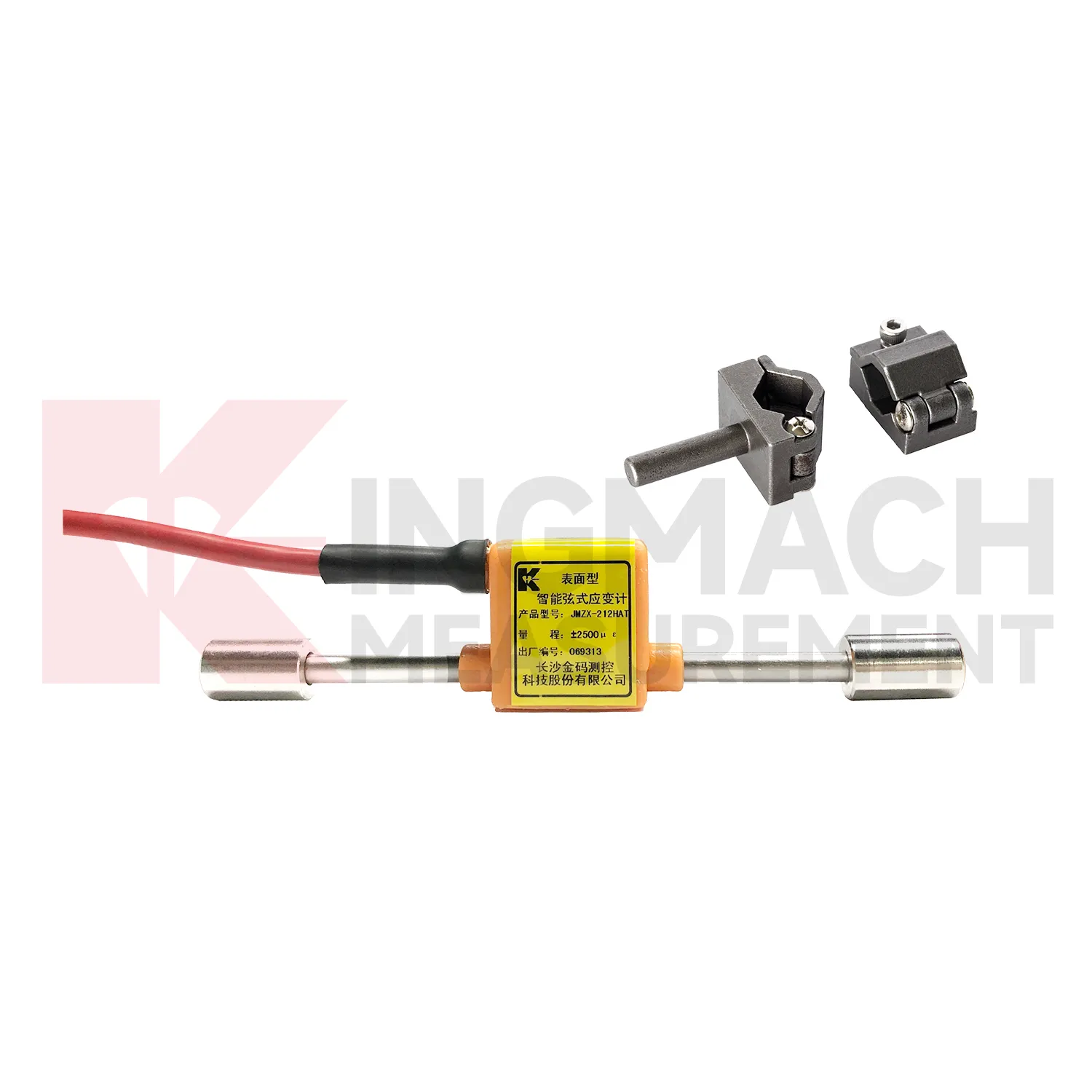
Surface-Mounted Strain Gauge (JMZX-212HAT/HB)
Technicians bolt or bond surface-mounted strain gauges directly to existing concrete or steel surfaces. You should choose this model for post-construction monitoring, structural retrofits, and dynamic load testing. This gauge also excels when drilling or casting into the host structure is impossible. The JMZX-212 series offers a standard measurement range of ±2,500 με with a resolution of 0.1 με. The fully sealed stainless steel housing ensures waterproof performance down to a 150-meter water depth.
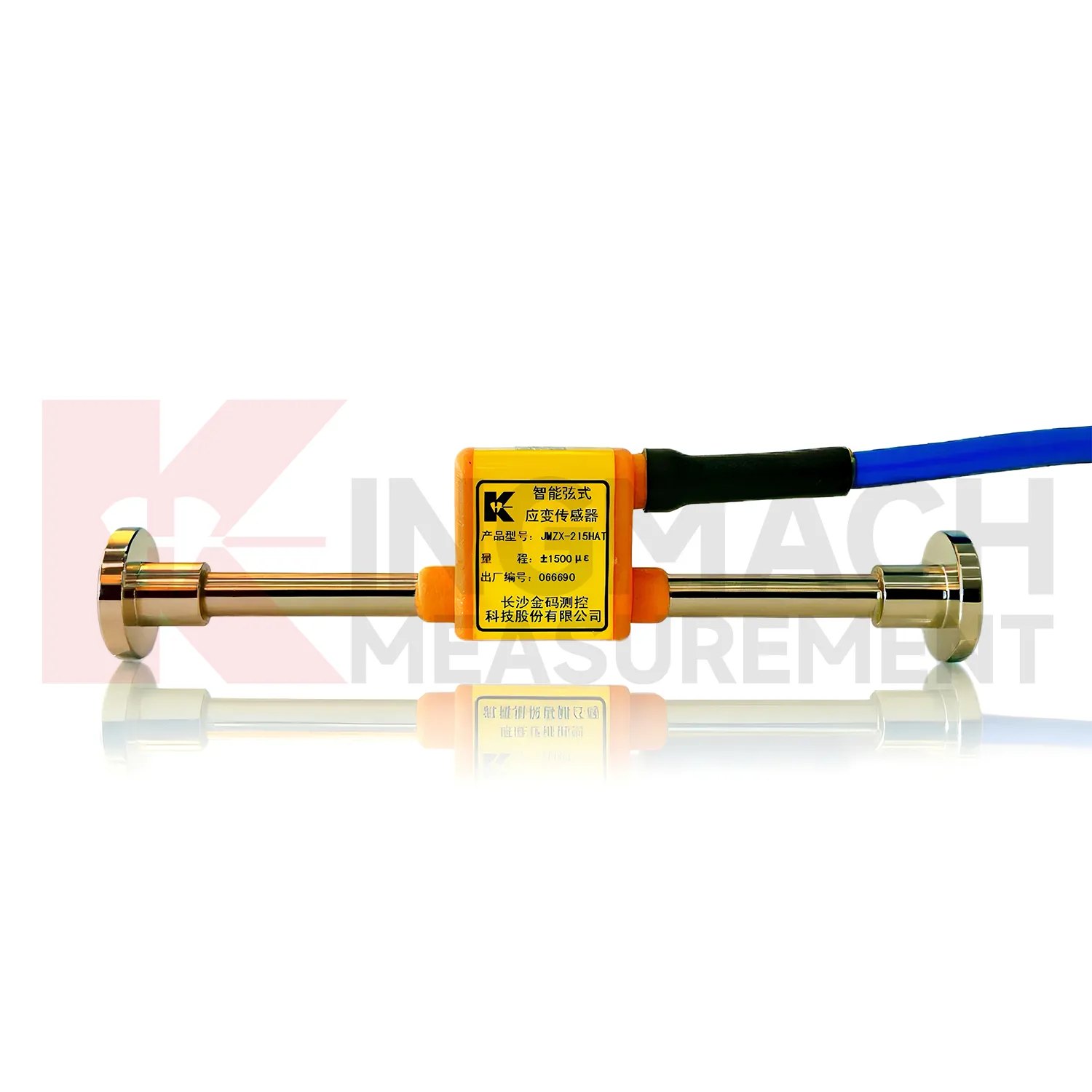
Embedment Strain Gauge (JMZX-215HA/215HAT/HB)
Construction teams cast embedment strain gauges directly into fresh concrete or bury them in structural fill materials. This represents the standard choice for new construction projects, including bridges, dams, tunnels, retaining walls, and foundation slabs. Embedment sensors require no shear-resistance from the base material, which makes the installation process exceptionally fast and reliable.
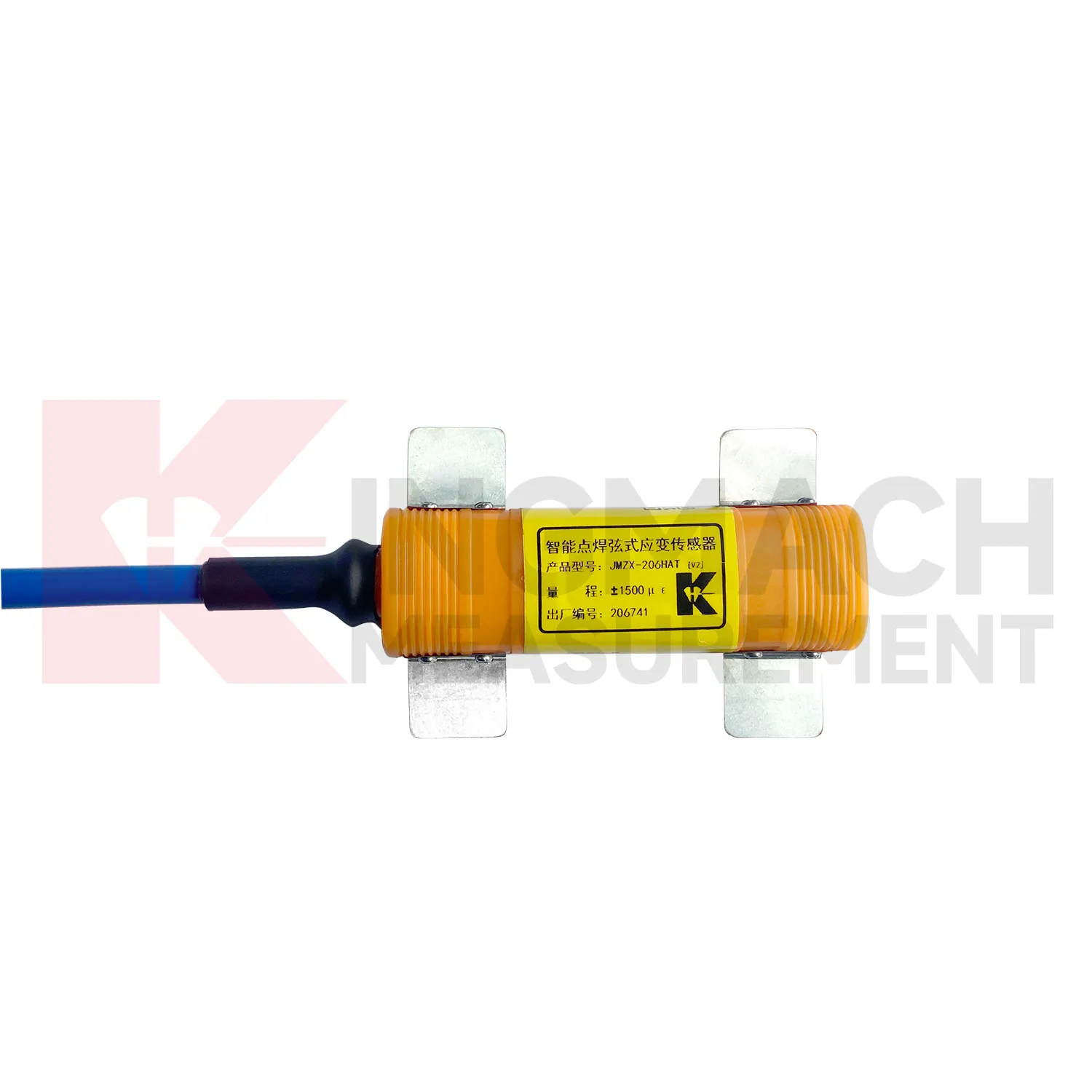
Surface-Welded Strain Gauge (JMZX-206HAT)
Welders attach surface-welded strain gauges directly to structural steel members like girders, sheet piles, and tubular piles. Welding delivers a highly consistent mechanical coupling on bare steel without relying on chemical adhesives. This permanence makes welded gauges the preferred option for marine and underground steel structures where epoxy bonding might degrade over time.
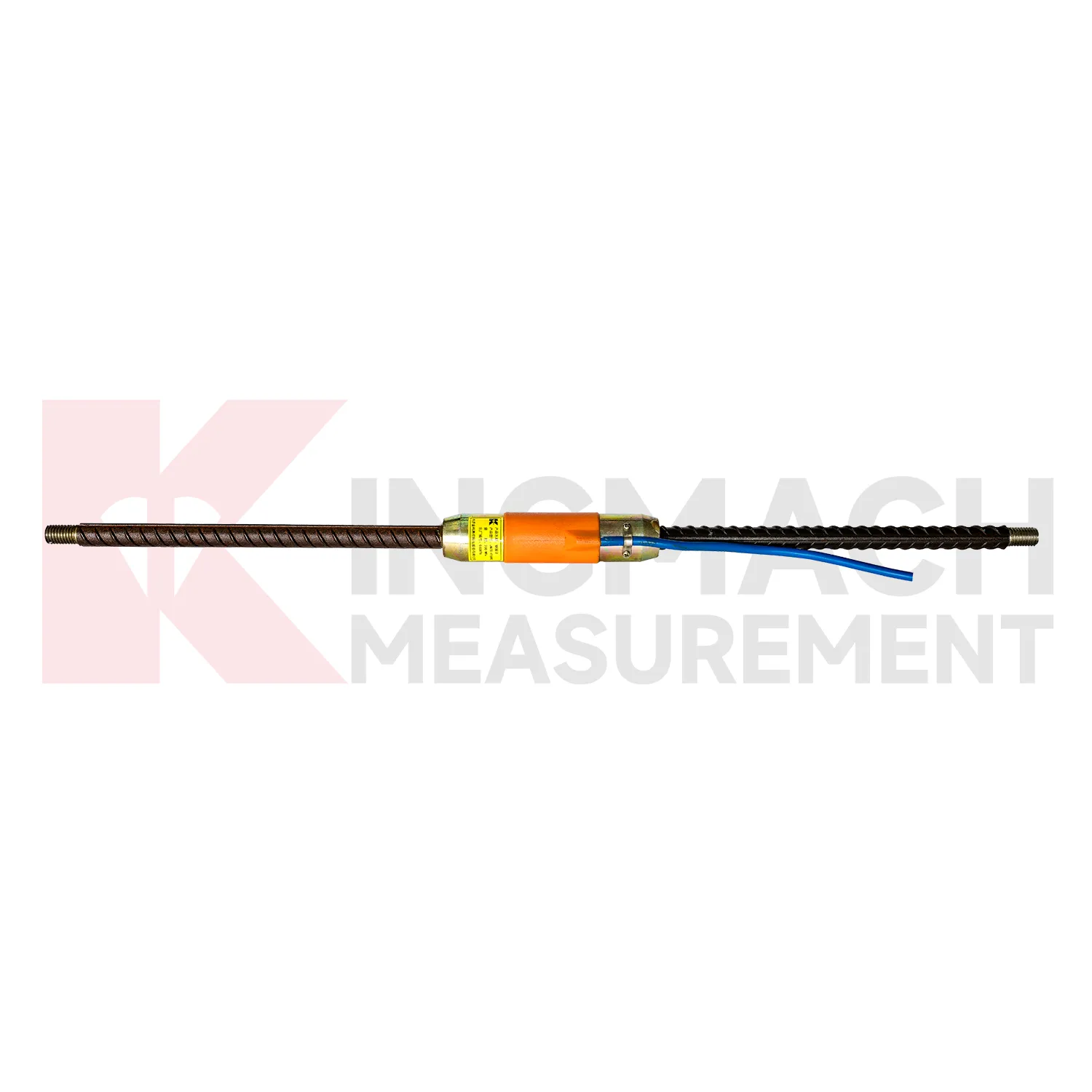
Rebar Strainmeter (JMZX-4XXHAT/HB)
Contractors splice rebar strainmeters directly into the steel reinforcement cage within concrete structures. These sensors measure the elongation and compression of the rebar to assess how loads transfer through columns, beams, and deep piles. You will find these instruments critical for high-rise building construction, foundation pit safety, and subway infrastructure.
| Gauge Type | Best Host Material | Installation Phase | Typical Application |
|---|---|---|---|
| Surface-Mounted | Existing Concrete / Steel | Post-Construction | Retrofits & Load Testing |
| Embedment | Fresh Concrete | New Construction | Bridge Decks & Dam Walls |
| Surface-Welded | Bare Steel Members | New / Post-Construction | Steel Girders & Piles |
| Rebar Strainmeter | Reinforcing Steel (Rebar) | New Construction | Foundation Pits & High-Rises |
Five Technical Parameters That Should Drive Your Final Specification
Once you select the appropriate installation type, you must evaluate the precise technical specifications. Five key parameters should drive your final procurement decision.
Measurement Range & Resolution: A standard ±2,500 με measurement range adequately covers most civil engineering applications. However, you also need high sensitivity. A high-resolution output of 0.1 με ensures that the sensor captures micro-deformations in pre-stressed concrete and steel elements under normal service loads.
Accuracy Class: An accuracy rating of 0.5% F.S. (Full Scale) acts as the benchmark for infrastructure-grade monitoring. High accuracy remains crucial when you calculate real structural stress from measured strain using the material's modulus of elasticity. You should always verify compliance with recognized certification standards, such as GB/T 13606-2007 or DL/T 1044-2022.
Waterproof Rating & Environmental Sealing: Many projects operate in harsh environments. A fully sealed stainless steel housing rated to a 150-meter water depth is essential. You need this level of protection for hydroelectric dam faces, tidal zone piles, and highly humid tunnel excavations.
Operating Temperature Range: Civil structures endure extreme weather. The built-in thermistor should span a wide range from −40 °C to +120 °C. Projects located in arctic climates or near industrial heat sources require this thermal resilience. Furthermore, accurate temperature correction prevents false alarms in your automated monitoring system.
Signal Output & System Compatibility: You must decide between standard VW frequency outputs and digital Smart variants (RS-485 / SDI-12). Smart sensors allow for multi-point bus wiring. This digital architecture can reduce heavy cable costs by up to 60% on large sensor arrays. As a practical note, Kingmach readout units and data loggers are factory-matched to the JMZX sensor series, which completely eliminates system integration risks.
Complement your strain monitoring with hollow load cells for complete cable force tracking — learn more in our Hollow Load Cell Guide →Hollow Load Cells for Bridge Cable & Anchor Monitoring: Selection Guide & Specifications
Matching Strain Gauges to Project Type: From Bridge Monitoring to Geotechnical Engineering
Matching the right sensor to the specific application is the hallmark of effective structural health monitoring. Different civil engineering domains require distinct measurement approaches.
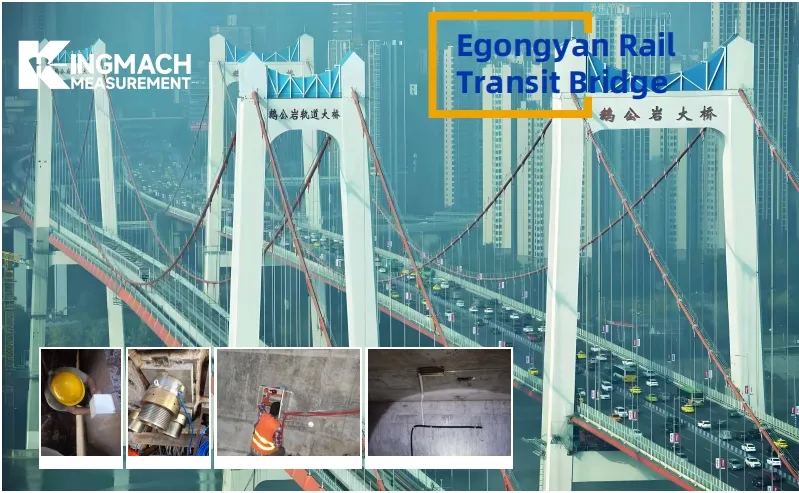
Bridge Monitoring: Bridge projects require a multi-faceted approach. Engineers cast embedment gauges into concrete deck sections and splice rebar strainmeters onto the steel reinforcement to measure live load responses and long-term concrete creep. Simultaneously, technicians use surface-welded gauges on the main steel girders to track ongoing fatigue cycles.
Tunnel & Underground Structures: Subterranean environments pose severe challenges with high humidity and corrosive groundwater. These conditions demand fully sealed, waterproof embedment gauges. Additionally, utilizing smart bus wiring significantly reduces installation complexity within confined tunnel headings.
Hydroelectric Dams & Retaining Walls: Dam monitoring relies heavily on embedment sensors cast deeply into the concrete body. The waterproof housings easily handle permanent submersion under heavy water pressure. The long-distance transmission capability of VW signals enables engineers to build massive sensor arrays across the dam face without installing intermediate signal repeaters.
High-Rise Buildings & Foundation Pits: Safety during urban excavation is paramount. Rebar strainmeters welded onto column cages and shear walls provide real-time load distribution data as construction phases progress.
Side Slopes & Geotechnical Projects: Slope stability requires continuous oversight. Engineers install surface-mounted or embedment gauges in shotcrete linings to monitor surface deformation and retaining wall stress.
Wind Tower Structures: Wind turbines endure massive cyclic loads. Surface-welded gauges attached to the steel tower sections effectively monitor bending fatigue and wind-induced dynamic strains.
Beyond the Sensor: How Strain Gauges Fit Into a Complete SHM Data System
You should always view a strain gauge as a single piece of a larger technological ecosystem. The sensor simply acts as the data origin point. The inherent accuracy of the gauge only matters if the entire transmission chain preserves that data without introducing electrical noise or signal loss.
Instrumentation cables play a massive role in data fidelity. You must use shielded, matched-impedance cables specifically designed for vibrating wire sensors. High-quality cables prevent signal degradation even over transmission runs that exceed 1,000 meters.
Next, you must consider the acquisition hardware. Kingmach’s automated data loggers and readout units support multi-channel polling. They allow engineers to configure precise alarm thresholds and utilize remote telemetry options, including 4G, WiFi, and LoRa networks.
Finally, visualization software transforms raw frequencies into actionable insights. Real-time digital dashboards display strain trends, temperature-corrected stress values, and automated alert levels. This integration enables unattended, 24/7 remote structural monitoring. Specifying your sensors, cables, loggers, and software from a single supplier eliminates communication protocol mismatches and drastically reduces commissioning time.
What to Look For When Sourcing Strain Gauges from an International Supplier
Procurement teams face unique challenges when evaluating international suppliers for structural health monitoring sensors. You must look beyond simple product specifications and evaluate the supplier’s operational reliability.
First, third-party certifications matter immensely. You should insist on traceable calibration records and strict compliance with recognized industry standards. Verified products significantly reduce your project approval risks. Second, you must evaluate delivery reliability. An ideal supplier maintains in-stock standard models for rapid dispatch while adhering to strict contractual delivery schedules for custom project-scale orders.
Third, comprehensive after-sales support separates reputable manufacturers from mere distributors. Look for suppliers offering a 24/7 technical hotline with rapid initial response times. This support becomes invaluable when remote projects encounter unexpected data anomalies. Fourth, assess their customization capabilities. Projects situated in extreme climates or confined spaces frequently require adapted gauge lengths, specialized housing materials, or non-standard connector types. Ultimately, choosing a single-source supplier who manufactures the sensors, cables, loggers, and software under one unified quality management system ensures total accountability.
Making the Right Choice: A Quick Decision Recap and Your Next Step
Selecting the perfect strain gauge is a methodical process. You must analyze the host material, identify the installation phase, verify the technical specifications, and ensure full system compatibility. The best strain gauge is rarely the cheapest option or the one with the most impressive laboratory specs. Instead, the right sensor is the one perfectly matched to your structural environment and long-term monitoring duration.
Are you unsure which sensor model suits your specific project? Need a sensor recommendation for your project? Share your requirements — Kingmach engineers reply within 24 hours.🔗 [Request a Free Project Consultation →]
FAQs
1. What is the main difference between surface-mounted and embedment strain gauges?
Technicians attach surface-mounted gauges to the exterior of existing structures using bolts or adhesives. Conversely, construction teams cast embedment gauges directly into wet concrete during the new construction phase.
2. Can vibrating wire strain gauges measure temperature?
Yes. Most high-quality vibrating wire strain gauges include a built-in thermistor. This component measures local temperature, allowing your monitoring software to automatically correct strain readings for thermal expansion and contraction.
3. Why use a surface-welded gauge over an adhesive-mounted one?
Surface-welded gauges create a permanent, metallurgical bond with bare steel structures. This welded connection provides superior long-term stability in harsh, damp, or underwater environments where chemical adhesives eventually degrade.
4. How far can a vibrating wire sensor transmit its signal?
Because vibrating wire sensors output a frequency rather than a voltage, they resist cable resistance changes. With proper shielded cabling, they can transmit accurate signals over distances exceeding 1,000 meters without external amplifiers.
5. What does a "Smart" vibrating wire sensor do?
Smart sensors utilize digital protocols (like RS-485 or SDI-12) and feature unique digital addresses. This allows engineers to connect multiple sensors along a single cable bus, drastically reducing wiring complexity and material costs.
6. Can vibrating wire strain gauges be used alongside load cells?
Yes. Vibrating wire strain gauges and load cells are commonly used together in structural and geotechnical monitoring. Load cells measure applied force, while strain gauges measure material deformation, providing complementary data for a more complete assessment of structural performance.
7. How to perform field calibration verification without factory recalibration?
Field verification can be performed by checking zero readings, comparing measurements with known reference loads, reviewing historical data trends, or cross-checking with other sensors. These methods help identify potential drift between formal calibration intervals without requiring factory recalibration.
Written by Kingmach Engineering Team — supporting infrastructure projects worldwide since 2001